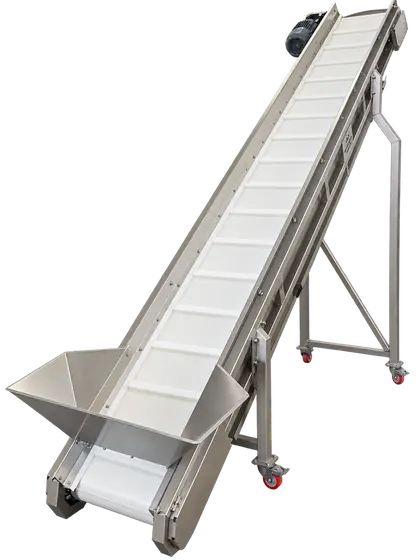
Cleat height and cleat spacing are set by the product and the incline, not by the belt width. A cleat has one job: to hold a layer of product on the belt while the belt climbs. If the cleat is too low or too far from the next one, product rolls back. If it is too tall or too close, product jams, bruises or leaves unevenly at the top.
The cleated belt elevator lifts product from a low feed trough on a food-grade PVC or PU belt with cleats. The belt is the same on every machine of this type. The cleat layout is what changes from one product to another.
What the cleat does on an incline
On a flat belt, product sits still because friction holds it. On an incline, gravity pulls it back down the belt. Smooth, round or wet product has little friction, so it rolls. The cleat gives the product a wall to rest against.
Each cleat carries the product that sits between it and the cleat before it. The pocket formed by two cleats is the unit of transport. Everything about height and spacing comes from the size of that pocket.
Cleat height
Height is chosen against the size of a single piece of product.
- Too low. Round product such as potatoes, onions or tomatoes rolls over the cleat on the climb. The belt then carries a thin, irregular stream and pieces fall back into the trough.
- Too tall. The cleat sweeps through the product at the infeed and pushes pieces aside instead of picking them up. At the top, a tall cleat can drag pieces against the discharge chute. Tall cleats also collect more soil and are harder to clean behind.
- About right. The cleat is tall enough to stop one piece from rolling over it, and low enough that the piece lifts cleanly off the belt at the turn.
Small or flat product, such as leafy pieces or cut slices, needs a different cleat than whole round product. A cleat that suits a large root vegetable is wrong for small cut pieces, which slide through the gap under it.
Cleat spacing
Spacing sets the size of the pocket and the amount of product each cleat carries.
- Spacing too wide. Several layers of product build up in one pocket. The upper layer rolls back over the lower one, and the pieces at the bottom of the pile are crushed by the weight above.
- Spacing too tight. Each pocket holds very little, so the belt must run faster to move the same flow. A faster belt throws product at the discharge and wears faster.
- Matched to the flow. The pocket holds about one layer of the product, and the belt speed is adjusted to the product, which the cleated belt elevator allows.
Capacity on this machine is set per project, so cleat layout is part of the project drawing, not a catalogue option.
Cleats and side walls
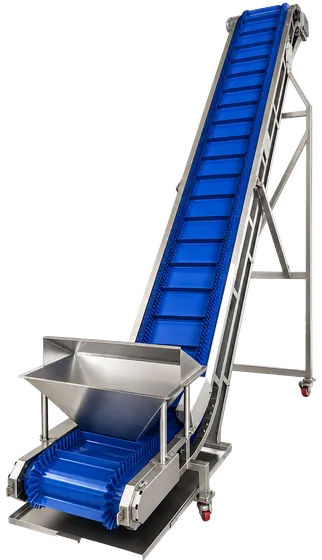
Cleats stop rollback along the belt. They do nothing about product that falls off the sides. Where the incline is steep or the product is round, side walls on the belt keep it in the pocket. The positive-drive elevator uses a cleated belt with side walls for this reason: sprockets drive the belt without slip, and the walls hold the product between the cleats.
Wet product changes the choice
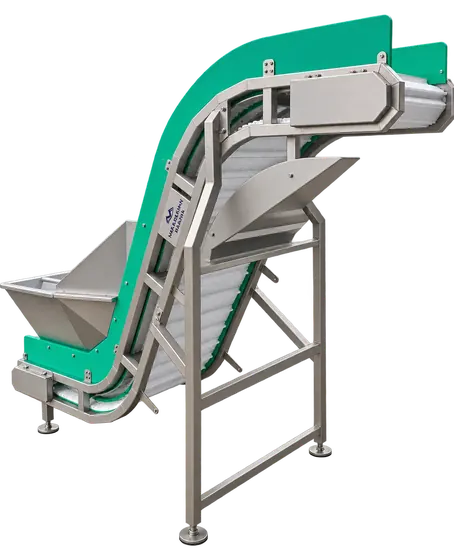
Wet product rolls back more easily than dry product. If the elevator sits after a washer, a cleat height that works on dry product from a feed hopper may be too low for the same product coming out of wash water. In that case a perforated modular belt is usually the better fit, since it drains the water while the cleats hold the product. That is the Z-type elevator, which reaches steeper transfer points than a PVC belt.
How to check a cleat layout on the line
The layout can be judged by watching the belt at three places.
- At the infeed. The cleat should pick product up, not push it forward in the trough. If product piles in front of the cleat, the cleat is too tall or the feed is too heavy.
- On the climb. Watch the pocket. If pieces roll back, the cleat is too low or the pocket is too long. If pieces are pressed against each other, the spacing is too wide.
- At the top. Product should leave the pocket as the belt turns and land in the chute. If pieces drop late or hit the chute wall, check cleat height and belt speed together.
Change one thing at a time. Speed is the easiest setting to adjust and should be tried before a new belt is ordered.
What to tell the supplier
A cleat layout is only as good as the information behind it. The following should be known before the belt is specified:
- The product, its size range and whether it is round, flat or irregular
- Whether the product is dry, wet or covered in soil
- The incline of the elevator
- The flow the elevator must carry
- What receives the product at the top
With these answers the cleat height and spacing can be drawn for the machine, and the belt speed can be set during commissioning rather than guessed.