A hopper in front of an elevator exists to turn a batch into a stream. A bin or crate is tipped in a few seconds, while the washer, sorter or packing machine downstream needs the same product spread over many minutes. The hopper holds the difference. If it is too small, product spills or the operator has to wait. If it is too large or badly shaped, product bridges, piles on one side and reaches the belt unevenly.
What the buffer has to cover
The buffer volume is set by the gap between how product arrives and how product leaves.
- How it arrives: a bin tip, a crate tipper, a batch from a harvest trailer or a continuous stream from another machine. A tipped bin arrives all at once.
- How it leaves: the belt takes product up at a rate set by belt speed and by how much product the trough lets onto the belt.
The hopper has to hold one full tip plus whatever is still on its way out from the previous one. Sizing it from the average rate alone is the usual mistake. The peak is the tip, and the peak decides the volume. Because capacity is set per project, the volume is worked out with the line in front of you, from the container size and the tipping interval, not copied from another installation.
Shape matters as much as volume
Vegetables and fruit do not flow like grain. Round product rolls, leafy or irregular product interlocks, and wet product sticks to the walls. A few rules follow:
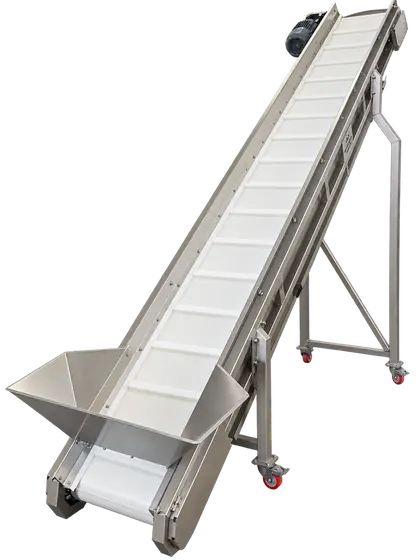
- A wide trough at the bottom. The cleated belt elevator has a wide feed trough that takes a heavy product flow, so product does not need to be squeezed through a narrow opening.
- Walls that slope towards the belt. Flat shelves inside the hopper collect product that never moves.
- No sharp internal edges. Edges mark soft product and catch skin and leaves.
- A smooth, easily cleaned surface. Frame and trough are AISI 304 stainless steel on the cleated belt elevator, and the construction is easy to clean.
Where the product lands
Where the tipped product lands inside the hopper decides how the belt is loaded. If it falls on one side of the trough, the belt carries product on one side only. If it falls from a height, the product at the bottom is bruised by the weight above it and by the drop.
Two small design choices help:
- Keep the drop from the tipper to the hopper floor short.
- Let the product land towards the back of the hopper and slide forward onto the belt, not directly onto the cleats.
Matching the hopper to the belt
The elevator belt does the metering. Speed is adjustable to the product, and the cleats on the belt define how much product each section carries. A hopper that delivers a thick mass onto a fast belt overloads the cleats, and product rolls back down the incline. A hopper that delivers too little leaves gaps, and the elevator runs half empty while the washer waits for product.
The way to find the right setting is to run the line at normal load and watch the belt just above the trough:
- Are the cleat pockets full, or only partly filled?
- Is product spilling over the sides at the bottom?
- Does the load stay constant during the gap between two tips, or does the belt run bare?
- Is the hopper empty by the time the next container arrives, or still half full?
If the pockets are partly filled and the hopper sits half full, the belt can run faster or the opening can be larger. If product spills at the sides, the opening is too wide or the belt too fast for what the cleats can hold.
Positive-drive version
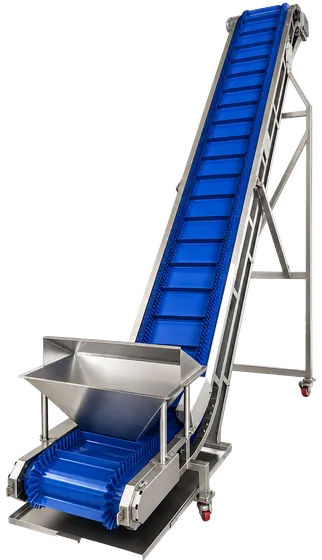
On the positive-drive cleated elevator, product enters from the feed hopper, sprockets drive the belt and the product is carried up between the cleats to the top discharge. Cleats and side walls keep it on the belt over the incline. The hopper still sets how evenly the product reaches the cleats, and the same questions apply: peak volume, flow shape and where the product lands.
Choosing between elevator types at the hopper
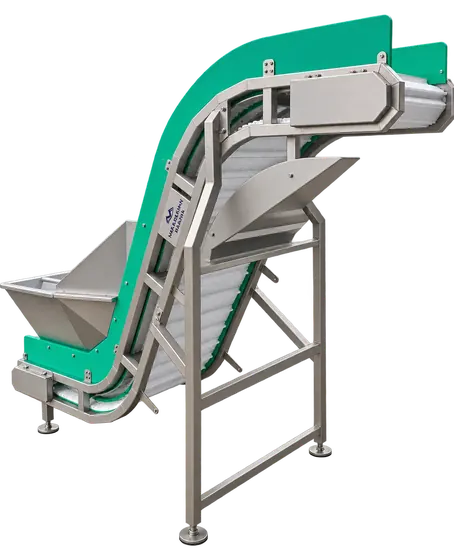
If product coming out of the hopper is wet or needs to drain, the belt choice matters more than the hopper. The guide on vegetable elevator types compares the cleated, Z-type and positive-drive elevators by belt, drive, wet product handling and layout, and the hopper is then fitted to the type that suits the product.
Checks once it is running
- Product should leave the hopper without raking or pushing by hand. If operators have to help it along, the slope or opening is wrong.
- Look for dead corners where product sits from one shift to the next. Dead corners are also a hygiene problem.
- Clean the hopper at the same interval as the belt. Both carry the same product.
- Check that the hopper is not so full that it overflows when the next container is tipped before the previous one has cleared.