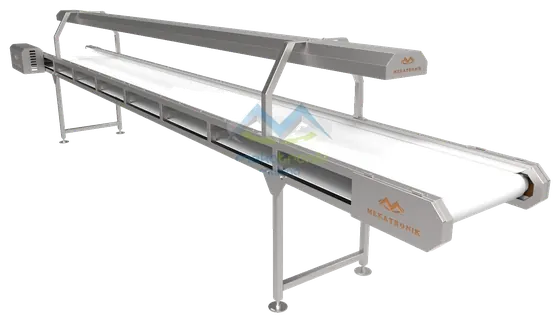
An inspection conveyor works only if a picker can see the foreign object and has time to reach it. Lighting makes the object visible, belt speed gives the picker time, and the position of each picker decides which part of the belt that person watches.
What the machine does
On the illuminated inspection conveyor, product passes under LED lighting so that foreign objects are easier to see and pick out by hand. The product page lists the body as AISI 304 stainless steel, the belt as food-grade PVC or PU, and the drive as a geared motor. The belt speed is adjustable with a frequency inverter, and speed control is listed as an option. Control is PLC or stand-alone.
In the typical washing and packing line shown on the product page, the inspection conveyor sits after the washer and the Z-type elevator and before the positive-drive elevator and packing.
Lighting
Light should fall evenly across the width of the belt. A belt that is bright in the middle and dim at the edges teaches pickers to look at the middle, and objects travelling along the edge pass unchecked.
- Avoid reflections that point toward the picker's eyes. Wet product shines, and a bright spot in the line of sight hides what is behind it.
- Avoid shadows. Light from one low angle casts a shadow behind each piece, and a small object can sit in that shadow.
- Keep the lit zone as long as the picking zone. Pickers who stand outside the lit zone work in worse conditions than the machine intended.
- Keep the light covers clean. Splashes and dust reduce the light without anyone noticing.
Belt colour and product layer
An object is seen by contrast. A dark foreign object on a pale belt is easy to see. The same object on a dark belt is not. The belt on this machine is a food-grade PVC or PU belt, so the colour chosen should contrast with the product that usually runs on it.
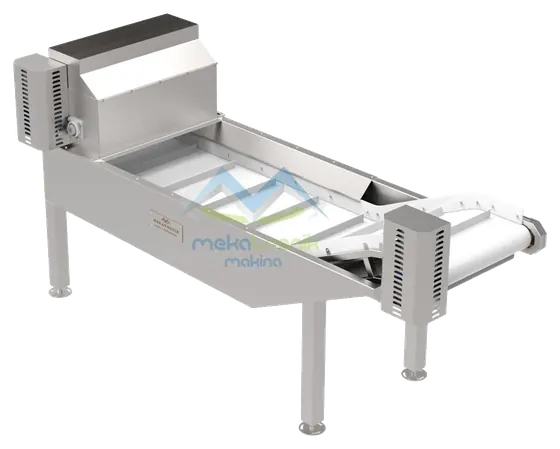
The product layer must be thin enough for the picker to see each piece. When product lies several layers deep, the objects lie below the top layer and cannot be seen at any speed. For that reason the infeed must spread product evenly across the belt. A cleated belt elevator or a feeder before the inspection conveyor sets how evenly it arrives.
Belt speed
Belt speed is a trade-off between throughput and picking time. A faster belt moves more product per hour but gives each picker less time per piece. A slower belt does the opposite.
There is no useful figure to quote without the product, the picker count and the size of the objects to be removed. A practical way to set speed is:
- Start with a low speed and a thin layer of product that has known foreign objects added.
- Raise the speed in small steps and watch how many of the added objects get picked.
- Stop raising the speed when pickers start missing objects, and go back one step.
- Repeat when the product changes, since a different product shows objects differently.
The frequency inverter makes these steps possible without changing mechanical parts.
Picking positions
Where people stand along the belt changes what they can do.
- Standing on both sides splits the belt width between two people, so no one has to reach far across.
- Standing one behind another along the belt gives each object more than one chance to be seen. The second picker takes what the first missed.
- The working height is set per project. The belt should be at a height where the picker can work with relaxed shoulders for a whole shift, since tired pickers miss more.
- A container for removed objects stands next to each position. If the picker has to walk away or carry objects over the belt, attention leaves the belt.
Checks during production
- Look at the lights at the start of the shift and make sure the whole width is lit.
- Watch the product layer at the infeed. A lumpy infeed produces a lumpy layer on the inspection belt.
- Ask pickers whether glare or shadow is bothering them. They notice first.
- Compare what comes out of the container with what is later found downstream. A recurring type of object at packing means the lighting or position is missing it.
The guide to vegetable elevator types shows where the inspection conveyor sits among the other machines in a line.