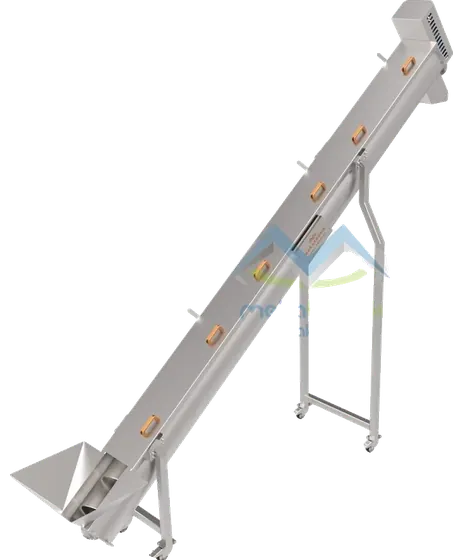
Choose a screw feeder when the product is small or loose, when it must be moved at a steady and adjustable rate, and when a covered body is useful. Choose a cleated belt elevator when a wide flow has to be lifted from a low trough to the next machine. The two machines solve different problems, even though both move product up and forward.
How the screw feeder works
On the screw feeder, product is loaded into the trough. The screw carries it along the covered body to the outlet at a steady rate. The body is AISI 304 stainless steel. Speed is set through the geared motor, and the rotation speed is set to the product through the choice of geared motor. The supply is 380 V / 50 Hz, and control is PLC or stand-alone.
Standard equipment is top covers for safety and easy cleaning, speed set through geared motor options, and lockable castors. The top covers open for cleaning. Capacity is set per project.
How the belt elevator works
The cleated belt elevator lifts product from a low feed trough to the next machine on a PVC cleated belt. Frame and trough are AISI 304 stainless steel, and the wide trough takes a heavy product flow. The belt is food-grade PVC or PU with cleats, and belt speed is adjustable to the product.
The practical differences
Rate control. A screw feeder moves product by turning, so the rate follows the screw speed. This gives a steady flow that suits feeding a machine that wants a constant amount. A belt elevator carries what the cleats pick up, which depends on how the product arrives in the trough.
Product shape. Small pieces and loose product can slip between cleats or roll back on a belt. A screw holds them in the flight of the screw and moves them forward inside the body, so they do not fall back.
Covered or open. The screw feeder has a covered body. Dust, splashes and insects stay out, and product stays in. The belt elevator is open, which makes it easy to see and clean, but it does not contain loose product the way a covered body does.
Width of flow. The belt elevator has a wide trough for a heavy product flow. A screw feeder is narrower and suits flows that are steady but not wide.
Gentleness. A belt carries product with little relative motion between pieces. A screw turns and rubs product against the body and the flights. Soft or fragile product can be damaged in a screw, and speed is therefore kept to what the product tolerates.
Which to choose
- Small or loose product that needs a steady, adjustable rate: screw feeder.
- Large pieces, soft or fragile product, or a wide flow to be lifted: belt elevator.
- Need to meter product into a downstream machine: screw feeder, since its speed sets the rate.
- Need to lift product to a different height with an inclined run: belt elevator, which is built for lifting on an incline.
- Need a machine that can be moved to different places: the screw feeder's standard equipment includes lockable castors.
Cleaning
Both machines are stainless steel and made to be cleaned, but they are cleaned in different ways. The screw feeder opens at the top, and the screw and body are reached by lifting the covers. The belt elevator is open, so the belt and cleats are reached directly; cleaning points differ because the belt surface has cleats to wash around.
Whichever machine is used, product left in the body overnight dries and sticks. Clear the machine at the end of the shift.
Where they sit in a line
On the product pages, a typical washing and packing line starts with the feed hopper and then a cleated belt elevator. A screw feeder stands at positions where small product must be metered, such as the infeed of a machine that needs a constant amount. The guide to vegetable elevator types shows how the pieces fit in a line.
Do not choose by name alone. A feeder and an elevator are named for what they do in the line, and a line sometimes needs both.