The elevator that takes product out of a washer carries more than product. Water comes with it, held on the surface of the vegetables and pooled between them. If the belt does not let that water go, the elevator lifts it to the next machine. This is why the elevator directly after a washer is usually built with a perforated belt that drains, rather than a closed PVC belt.
What a closed belt does with water
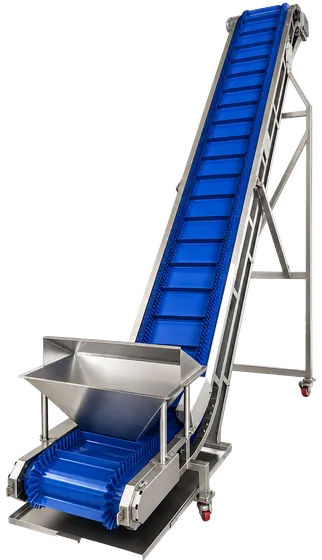
On a closed PVC or PU belt the water has nowhere to go but along the belt. On an incline it runs back down towards the infeed and collects behind each cleat. Product sitting in that water stays wet all the way up. At the top the belt turns, the product drops into the next machine and most of the collected water drops with it.
The next machine then receives the water the washer was supposed to remove. On an inspection table it wets the working area. On a packing machine it is the reason the product needs another drying step.
A closed belt also returns wet. On the return run under the frame, water and small pieces of product drip off the belt and onto the floor along the whole length of the elevator.
How a perforated modular belt handles it
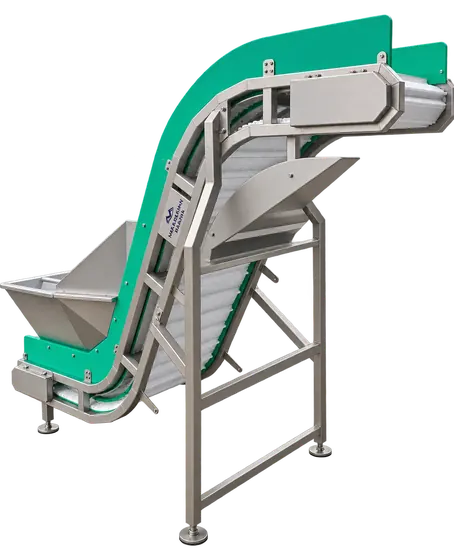
A modular belt is built from plastic modules joined by rods. In the perforated version each module has openings, so water drains down through the belt as soon as the product leaves the wash water. The product goes up the incline already draining.
The Z-type modular belt elevator uses this kind of belt. Its belt does not hold water, takes high temperatures and comes apart for cleaning. The Z layout has a horizontal section at the bottom, a steep section in the middle and a horizontal section at the top. The bottom section sits under the washer outlet and lets most of the free water drain before the climb starts.
Where the water goes
A draining belt only moves the problem if the water has no planned path. Three points are checked when the elevator is placed:
- Under the infeed section. Most of the water leaves here. A collecting tray or a drain under this section keeps it off the floor.
- Along the incline. Water that drains on the climb runs down inside the frame. The frame and the tray should lead it back to the bottom, not let it drip at random points.
- At the discharge. Only surface moisture should be left. If water still drops from the top, the drain time on the belt was too short.
Cleats on a wet belt
Cleats stop the product from rolling back on the incline. On a wet line they also hold back water if they are solid and the belt is closed. On a perforated modular belt, water passes through the belt in front of each cleat, so the cleat holds product without holding a pool of water.
Cleat height depends on the product and the incline. A low cleat on a steep, wet incline lets round vegetables roll over it. A cleat much taller than the product only adds surfaces to clean.
When a closed belt is still fine
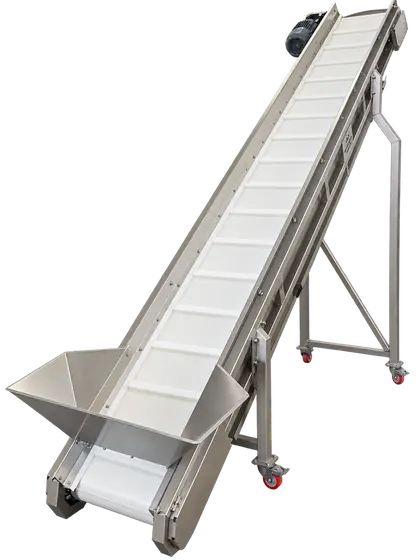
Not every elevator in a vegetable line sees wash water. A cleated belt elevator with a PVC belt works well for dry or lightly wet product: product coming from a bin or a crate tipper before washing, or product that has already been dried. Its wide trough takes a heavy flow at the infeed.
The question is simply where the elevator sits. Before the washer, a closed cleated belt is usually enough. Directly after the washer, the belt should drain. The guide to vegetable elevator types compares the three common types side by side.
Cleaning after a wet shift
A wet line leaves soil, peel and small pieces in every corner of the elevator. Points to check at the end of the shift:
- The belt surface and the openings in the modules
- The space behind each cleat
- The return run and the rollers under the frame
- The tray under the infeed section
- The discharge chute at the top
A modular belt can be taken apart module by module when a section needs a thorough clean, and individual modules can be replaced if they are damaged.
Before the next machine
The elevator after the washer usually feeds an inspection or sorting step. Product that arrives drained is easier to see and to pick. On an illuminated inspection conveyor, wet product reflects the light and water spreads over the belt; drained product shows foreign objects more clearly under the LED lighting.
When the elevator, the tray and the next machine are planned together, the water leaves the line at one place, under the washer, instead of following the product along the line.