Residue collects where product slows down, where surfaces meet, and where water cannot drain. On an elevator conveyor that means the feed trough, the area around cleats, the belt underside, the drums or sprockets, and the discharge. A washdown that skips these places leaves the soil that matters.
Why stainless is not enough
Stainless steel does not rust, and its surface is smooth enough to wash. It does not clean itself. Vegetable soil, sap and starch dry on any surface and become much harder to remove. Stainless makes cleaning possible; the routine makes it effective.
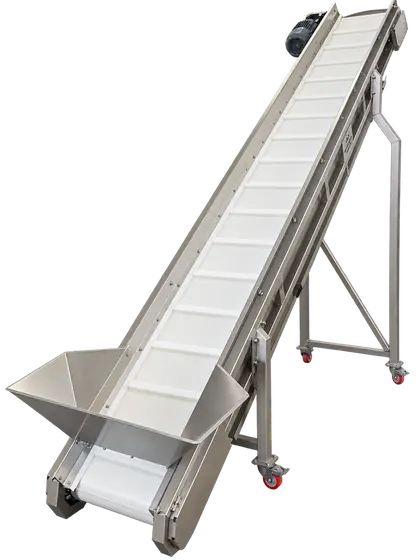
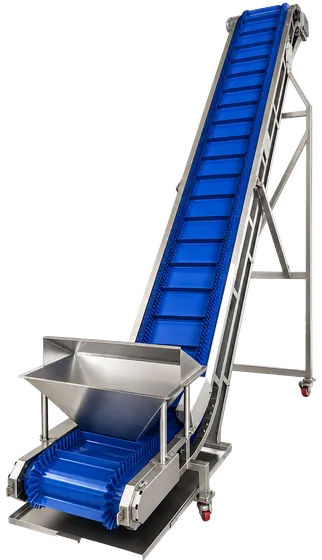
The elevator machines on this site have AISI 304 stainless steel bodies or frames. That covers the frame and the trough on the cleated belt elevator, whose product page lists an easy-to-clean construction. The belt is food-grade PVC or PU with cleats.
The cleaning points
Feed trough. Product enters here and stays longest. Residue collects in corners and along the lower edge. This is the first place to check, since product with soil from the field leaves the most there.
Cleats and the belt surface. Cleats are raised bars. Soil collects at the base of each cleat where it joins the belt, and in the gap between cleat and side wall if the belt has one. Wash at an angle that reaches behind each cleat.
Belt underside and return run. The returning belt carries residue that stuck to its surface. Dirt falls from the return run onto the frame and floor. Check under the machine, not only on top.
Drums or sprockets. The drive and tail drums collect fine soil and sap. On a sprocket-driven belt, the sprocket teeth hold residue between them.
Discharge. The top edge, where product leaves, collects pulp and juice from crushed pieces.
Frame joints and supports. Box-section frames have corners and welds. Water and soil hide in the lower corners and on horizontal surfaces.
How belt type changes the routine
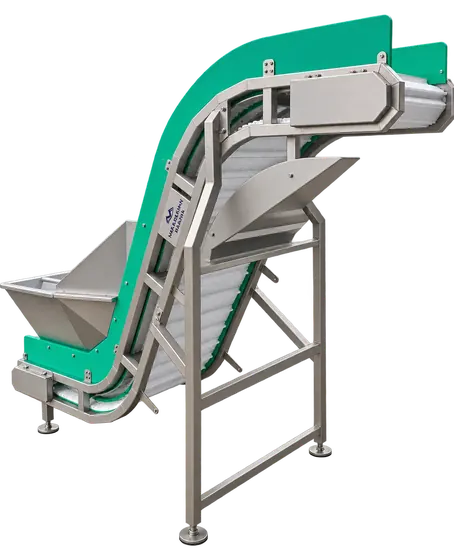
On the Z-type modular belt elevator, the belt is a perforated modular belt that drains water, takes high temperatures and is easy to clean, according to the product page. Perforations let wash water pass through the belt, so the underside is reached from above. Because the belt is made of separate modules, the joints between them are the places to look at.
On the cleated PVC belt, the surface is closed. Water runs off the belt but does not pass through it, so wash from above and then check underneath.
A belt with side walls adds corners at the edges, which need a spray directed along the wall.
End-of-shift routine
- Stop and isolate the machine so it cannot start during cleaning.
- Remove loose product and large debris by hand.
- Rinse the machine from the top down, so dirty water does not fall on parts that are already clean.
- Wash the belt surface and the cleats while moving the belt slowly, if the machine allows it, so the whole belt passes the spray.
- Clean the trough, drums or sprockets, and the discharge with a brush where needed.
- Check the underside and the frame for residue.
- Rinse again and let the water drain.
Covers and other machines
Not every machine on the line opens the same way. On the screw feeder, top covers open for cleaning. That makes the screw and the body reachable, which a closed body would not allow. When the line uses both elevators and a screw feeder, the routine is written for each machine separately.
Cleaning agents and temperature
The product pages do not specify cleaning agents, so follow the plant's approved cleaning plan and the belt maker's limits. The Z-type elevator's belt takes high temperatures, which means hot water is possible on that belt. Do not assume the same for a PVC belt without checking.
Checks that show the routine works
- Look at the trough corners with a torch after washing. Soil remains there first.
- Run a clean, damp cloth along a cleat base. It should come away clean.
- Smell the machine in the morning. A sour smell means residue stayed somewhere.
- Check at the next shift's start whether anything is stuck to the belt.
The guide to vegetable elevator types lists the machines of a line so that each gets its own cleaning checklist.