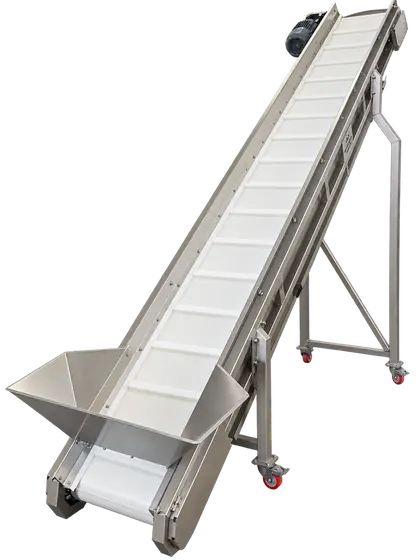
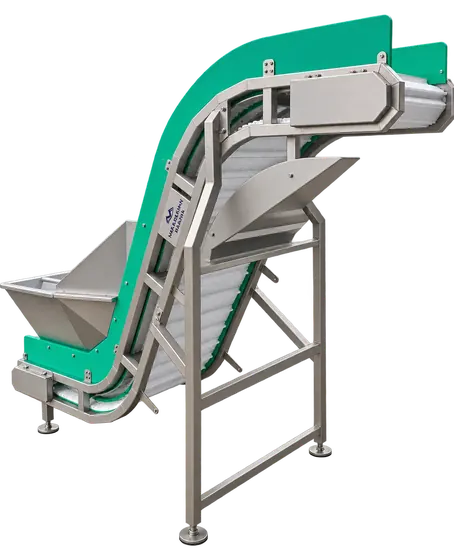
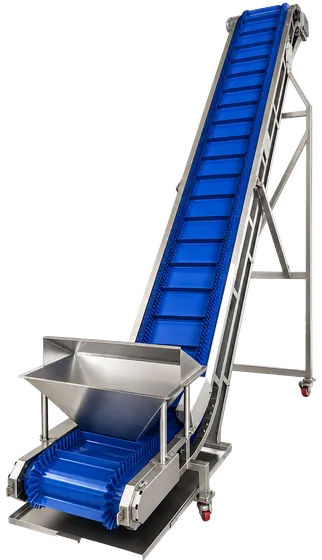
The incline of an elevator conveyor is limited by what the product does on the belt. If it stays where it is put, the belt can climb. If it slides or rolls back, the incline is too steep for that belt and that product. The product, the belt surface and the features on the belt, such as cleats and side walls, set the limit together.
Why product rolls back
Product on an inclined belt is pulled down along the belt by gravity and held up by friction with the belt surface and by anything standing in its way. When the pull is greater than the hold, product slides or rolls back toward the infeed.
Three things move that balance.
- Shape. Round pieces roll. Flat pieces tend to slide. Irregular pieces catch.
- Surface. Wet product on a smooth belt slides much more easily than dry product. Water forms a film between the product and the belt.
- Pile. A thick pile pushes on the pieces below it, so the lower layer may slide even if a single piece would stay.
For this reason there is no single incline figure that fits every product. The same belt that holds dry, irregular pieces at a given slope may lose wet round ones at a lower slope.
What cleats do
Cleats are raised bars across the belt. A piece that begins to slide meets a cleat and stops. The cleated belt elevator lifts product from a low feed trough on a food-grade PVC or PU belt with cleats. Cleats raise the incline that the belt can handle, because the product no longer relies on friction alone.
Cleat height and spacing then become the limit. Pieces smaller than the gap between cleats can still escape through a cleat gap, and pieces that are larger than the cleat height can ride over it. Setting these is a product-dependent choice.
What side walls do
On an inclined belt, product can also fall off the sides. Side walls keep the product on the belt. The positive-drive cleated elevator uses cleats together with side walls, so the product stays between the cleats and inside the walls on its way up.
Side walls do not stop rollback along the belt. They only stop the sideways loss. Both features are needed on a steep incline.
What the drive has to do
Friction-driven belts rely on grip between the drum and the belt. On a steep incline, with a loaded belt, the grip is under more load, and a belt that slips loses its position. The positive-drive elevator drives the belt with sprockets instead of friction, so it carries product up the incline under control. The product page describes the drive as a sprocket drive to the belt, with top discharge.
A friction drive is not wrong. It works where the load is modest and the belt can be tensioned properly. A positive drive becomes more valuable as the incline and the load increase.
When a different belt type is needed
Some transfers are too steep for a PVC belt, even with cleats. The Z-type modular belt elevator is described on its product page as reaching steep transfer points that a PVC belt cannot. It uses a perforated modular belt in a Z layout. The belt drains water, takes high temperatures and is easy to clean. The vertical part of the Z lifts the product at a steep section, built into the layout rather than into a single inclined belt.
What else limits the incline
- Product damage. A steep belt with cleats can pinch or crush soft product at the point where the belt bends over the drum. Gentle bends protect delicate pieces.
- Discharge. At the top, product leaves the belt. Too steep a belt throws product farther than intended.
- Capacity. Capacity is set per project. A steeper belt with the same speed may carry less per metre of belt, since product has to be spaced between cleats.
- Space. A steeper incline needs less floor length, but it needs more height. The room available often decides the incline before the product does.
Questions to answer before choosing
- What is the product, and is it wet or dry on arrival?
- How high must the product be lifted, and how much floor length is there?
- Does it need cleats, side walls or both?
- Does the drive need to be positive?
- If none of these solves the transfer, is a Z layout with a modular belt the right machine?
The guide to vegetable elevator types compares these machines side by side.