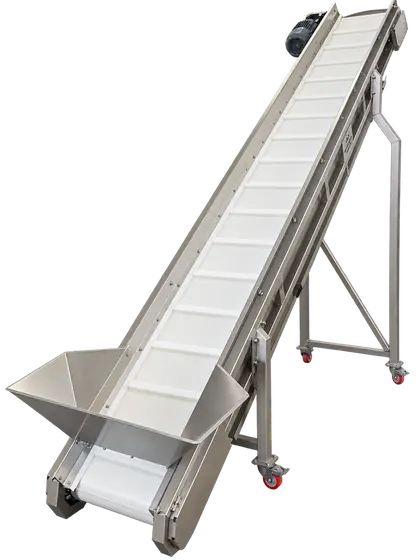
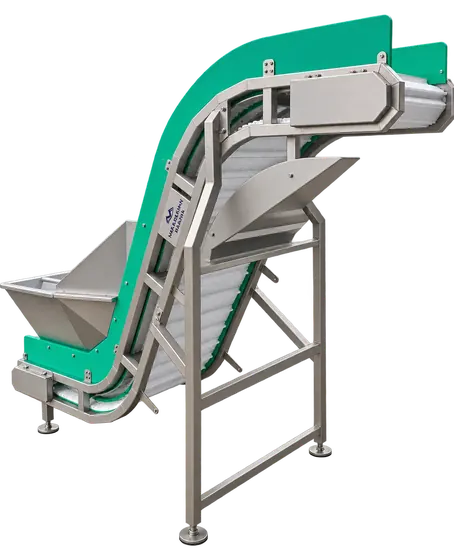
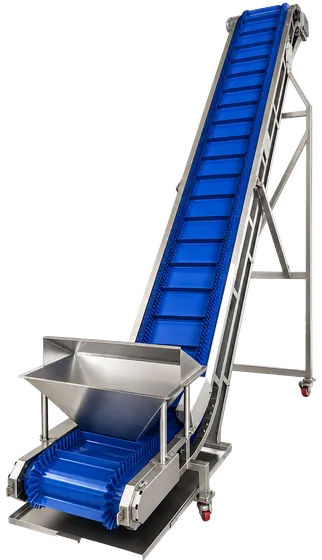
A Z-type elevator has three sections. The infeed section takes product from the machine before it, the lift section raises it, and the discharge section sets it down at the next machine. The shape of the belt follows the letter Z, with a lower horizontal run, a rising middle run and an upper horizontal run.
The machine in short
The Z-type modular belt elevator is a Z-shaped elevator with a perforated modular belt. The product page says it reaches steep transfer points that a PVC belt cannot. The belt does not hold water, takes high temperatures and is easy to clean. The body is AISI 304 stainless steel, the drive is a geared motor, and the supply is 380 V / 50 Hz. Capacity is set per project, and dimensions are built for the installation.
Infeed section
The infeed is the lower horizontal run. It receives product from the machine before it, which in the typical line on the product page is a washer. The lower run gives the product time to settle onto the belt before it begins to climb.
What matters here:
- The product should land on the belt, not bounce off it. A short drop to the belt is better than a long one.
- Water should leave through the belt perforations. The perforated modular belt drains water, so the product starts the climb already without standing water.
- The product should be spread across the belt width. A pile in one spot reaches the lift section as a lump.
Lift section
The lift section is the rising run in the middle. It carries product from the lower level to the upper level. This is the section that makes the Z layout useful, because it reaches steep transfer points that a flat PVC belt cannot reach.
Product on a steep belt tends to roll back. The lift section handles that, and the modular belt layout is designed around it. What keeps product on the belt is the belt structure and the layout of the lift, and these are set per project. For the factors that limit incline in general, see the cleated belt elevator, which solves the same problem with cleats on a PVC belt.
Because the lift section is the longest, it is also where belt tension and cleanliness matter most. A belt that is too slack lets the modules sag between supports. A belt that is too tight wears the sprockets and the modules.
Discharge section
The discharge is the upper horizontal run, where the belt levels out and releases the product. It is the part that determines how the product lands on the next machine.
- The product should leave the belt in an even stream. A stream that drops in bursts overloads the next machine.
- The drop to the next machine should be short, because a long drop damages soft vegetables.
- Water that travels with the product should already be drained. Wet product that reaches the next machine in a lump can block its infeed.
Why the belt is made of modules
A modular belt is made of separate plastic modules joined by rods. This allows the belt to run around the bends of a Z shape and to be repaired by replacing a single module. The perforated version has openings in each module, which lets water drain and also lets a wash stream reach through the belt during cleaning.
Fitting the layout into the line
A Z-type elevator is chosen for position as much as for height. In the typical washing and packing line on the product page, it stands after the washer and before the inspection conveyor. The washer leaves wet product, the Z-type elevator drains and lifts it, and the inspection conveyor receives it on a lit belt.
Questions that decide the layout:
- What is the height difference between the infeed and the discharge?
- How much floor length is available for the lower and upper horizontal runs?
- Does the product arrive wet or hot? A perforated modular belt is made for both.
- Which side does the discharge face, and does the next machine sit under or beside it?
Answers to these questions set the length of each section, which is why dimensions are built for the installation and not taken from a fixed list.