A belt that drifts to one side is telling you that something is unequal across the width of the machine. It may be the load, the drums, the frame or the belt itself. The drift looks the same in each case, so the check has to be done in order, from the cause that is easiest to see to the one that needs the machine stopped. Left alone, a wandering belt rubs its edge against the frame, tears at the cleats and sends product over the side.
Why belts wander
A belt moves towards the side where it is tighter or where it meets the drum first. In practice that comes down to a short list:
- Uneven loading. Product piled on one side pulls the belt that way.
- Drums that are not square to the belt path. If one end of a drum sits further forward than the other, the belt walks towards the tight side.
- A frame that is out of true. Incline frames can twist after a knock or a wash-down with a heavy load.
- Uneven tension. Adjusters set differently on the two sides produce a belt that is tighter on one edge.
- Build-up on drums. Residue on one end of a drum changes its effective diameter.
- A belt that is worn, stretched or joined unevenly.
Check the load first
This is the cheapest check and it needs no tools. Watch the belt at the bottom of the incline while product is running. Is the product spread across the belt, or is it piled on one side? If the feed is lopsided, the belt will wander, and no amount of drum adjustment will hold it. The fix is at the hopper or the chute that feeds the elevator, not at the drums.
Run the belt empty for a few minutes. If it tracks straight empty and drifts only under load, the cause is the load.
Friction drive and positive drive behave differently
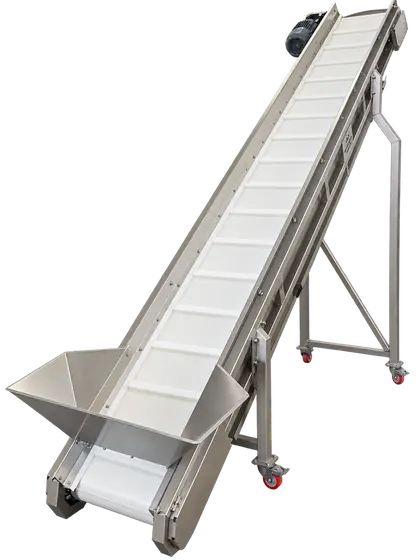
On a friction-drive belt, the drive drum moves the belt by friction. Tracking depends on the drum alignment and on tension, since a belt that is too slack slips and one that is too tight loads the edges. The cleated belt elevator uses a food-grade PVC or PU belt with cleats and a geared motor, with belt speed adjustable to the product.
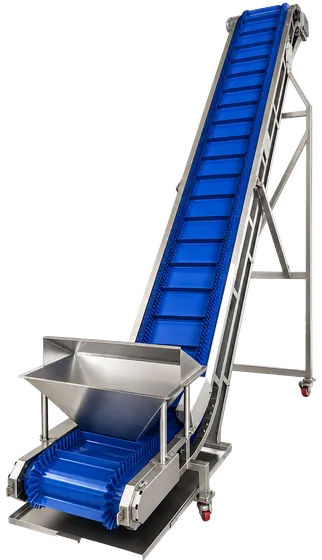
On a positive-drive belt, sprockets engage the belt directly, so the belt cannot slip on the drive drum and does not need the high tension a friction drive needs. The positive-drive cleated elevator uses a sprocket drive and cleats with side walls. The sprockets hold the belt laterally to some degree, but they do not make alignment irrelevant: the return drum and any idlers still have to be square. The article on positive-drive and friction-drive belts covers slip, tension and cleaning for the two drive types.
Check sequence with the machine stopped
Lock out the machine before touching anything.
- Look at the belt edge. Is one edge scuffed, frayed or polished? The scuffed side is where the belt has been rubbing.
- Look at the drums. Is there build-up on one end? Clean it off and see whether the belt behaves differently.
- Check the adjusters on both sides. Take-up screws or similar adjusters should be at the same setting. Record the setting before changing anything.
- Sight along the frame. A twisted frame is often visible as the belt rides on one side of the guide.
- Check that the drums are square. Measure across both ends of the drum against a fixed reference on the frame.
- Look at the belt joint where there is one. A joint that is not square pulls the belt sideways on every pass.
Adjusting
Adjust one thing at a time and run the belt empty after each change. The usual rule for a friction-drive belt is that the belt moves towards the end of the drum where it meets it first, so a drum is adjusted by moving one end a small amount and watching the belt for several revolutions before touching it again. Small steps, long waits. Overcorrection gives a belt that swings from one side to the other.
After the belt runs straight empty, load it and watch it again, since a tracking setting that works empty can fail under load.
Wet lines
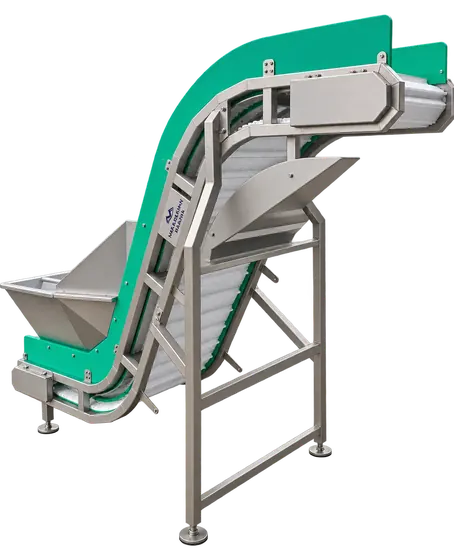
On a line after a washer, water and residue make the problem worse. Water on the drum surface reduces grip and lets the belt slip sideways, and residue builds up unevenly. The belt choice matters as well. A perforated modular belt, as on the Z-type elevator, does not hold water, and its modules are driven by sprockets rather than by friction. Tracking on a Z layout still depends on the horizontal sections being aligned with the steep section between them.
Signs to watch for in day-to-day running
- Scuff marks on the frame or guide rails.
- Cleats that are bent or worn on one side only.
- Product on the floor on one side of the elevator.
- A belt noise that is louder at one point of the revolution.
Any of these means the belt is already running against something. Check the tracking before the next shift, and clean the drums as part of every wash-down.