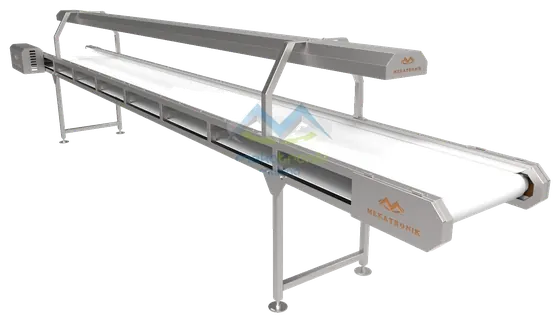
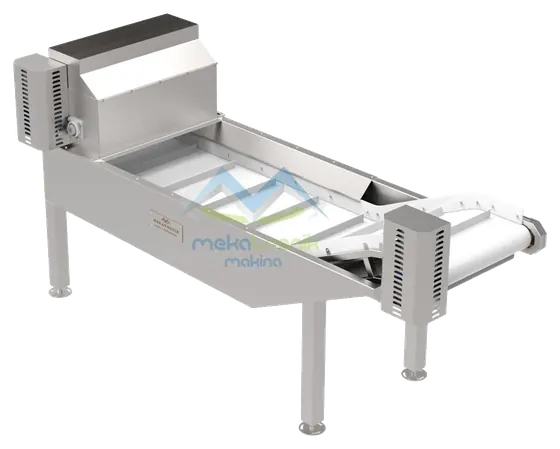
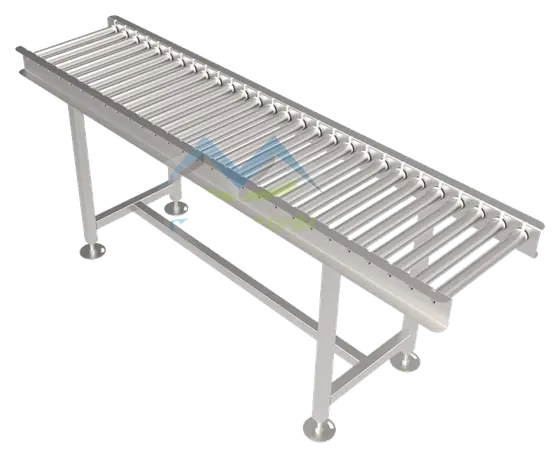
In wet processing, the conveyor has to deal with water before it deals with anything else. Water carried along with the product ends up in the next machine, on the floor, or in the packaging. Heat from blanching or hot washing softens belts that were chosen for dry duty. A conveyor for wet processing is chosen on two properties: whether the belt drains and whether it takes the temperature of the process.
Why a closed belt struggles with water
A closed PVC or PU belt is a good choice for dry or lightly wet product. It does not drain: water that comes with the product stays on the belt, runs back down the incline, or is carried to the discharge. The vegetable elevator types guide says it plainly: product coming straight out of a washer is better handled on a perforated belt.
A perforated modular belt is built from plastic modules joined by rods, with openings through the modules. Water drains through the belt instead of travelling with the product. The belt also takes high temperatures and comes apart for cleaning, which suits stages after washing and blanching.
What drainage changes downstream
Drained product behaves better at every following stage:
- Packing. Surface water carried into a pack shortens shelf life and wets the packaging.
- Sorting. Pickers see product more clearly when it is not covered in water.
- Next machine. A dryer or a cutter works against free water and wastes capacity on it.
- Floor. Less water falling off the line means less to clean and fewer slip hazards.
The article on the elevator after a washer explains why the belt must drain, and the same reasoning applies on a horizontal line conveyor.
Heat
Process steps with hot water or steam heat the belt as well as the product. A belt material has a limit, and a belt run above it softens, stretches and loses shape, which then shows up as tracking problems and uneven cleats. The perforated modular belt used on the Z-type elevator is described as drained and heat resistant, with a layout that runs horizontally at the bottom, climbs steeply and runs horizontally again at the top. The product pages give the belt material; the operating temperature for a particular line is something to settle with the manufacturer when the line is specified, since no figure should be assumed.
Block-breaking in wet lines
Some products stick together during washing or blanching and come out as blocks. Blocks cause problems downstream: they jam hoppers, are cut badly, cook unevenly and feed the pack unevenly.
The wet block-breaking conveyor separates product that has stuck together in blocks back into single pieces during wet processing. Its perforated modular belt does not hold water and takes high temperatures, so the same property that suits it for wet duty is what lets the product be worked while wet. Body is AISI 304 stainless steel and the drive is a geared motor.
Where it fits is after the stage that causes the sticking, and before the stage that needs single pieces.
Choosing a belt for a wet line
A short set of questions decides most cases:
- Is the product wet when it reaches this conveyor? If yes, a perforated belt.
- Does the product or the water arrive hot? If yes, a belt material that takes the heat. Confirm the limit for the line.
- Does product stick together? If yes, consider a block-breaking stage.
- How is the machine cleaned? A modular belt comes apart for cleaning, which matters where residue collects in the joints.
- Is there a lift? A Z layout reaches steep transfers that a PVC belt cannot, and a straight incline suits a moderate rise.
Drainage layout
Perforation alone is not enough if the water has nowhere to go. Check what is under the belt:
- Water should fall into a tray or drain, not on the floor or onto the motor.
- The drain should not be blocked by pieces of product that fall through the openings.
- The frame should not hold standing water in corners.
Small pieces fall through perforations. That is a feature for water and a loss for product, so the module opening is matched to the product size when the line is specified.
Cleaning wet-line conveyors
Product residue and water together are a hygiene problem. Stainless frames and easily cleaned belts matter more here than anywhere else in the line. Wash the machine on the plant's hygiene schedule, lift or open the belt where the design allows, clean the drums and the underside, and check that drains are clear before restart.