Product rolls back on an incline elevator when the belt surface and the cleats cannot hold it against gravity, and it spills over the edge when nothing contains it sideways. Cleats deal with the first problem. Side walls deal with the second. Most complaints about "losing product on the lift" come from treating the two as one problem.
Two different losses
Rollback is movement along the belt, back down the incline. Round or smooth product such as potatoes, onions or whole tomatoes can roll back between cleats when the slope is steep or the belt is wet. Spillage is movement across the belt, over the edge. It shows up when the feed is uneven, when the belt wanders, or when product is dropped onto one side.
You can tell them apart at the machine. Product found at the bottom of the incline, under the feed trough, points to rollback. Product found on the floor beside the frame points to spillage.
What cleats do
A cleat is a transverse rib on the belt. It gives the product a shoulder to rest against on the way up. The cleat has to be tall enough for the product size and spaced so that a piece sits behind it instead of riding over it. The details of height and spacing are covered in cleat height and spacing on elevator belts. Cleats do not stop product leaving the belt sideways.
What side walls do
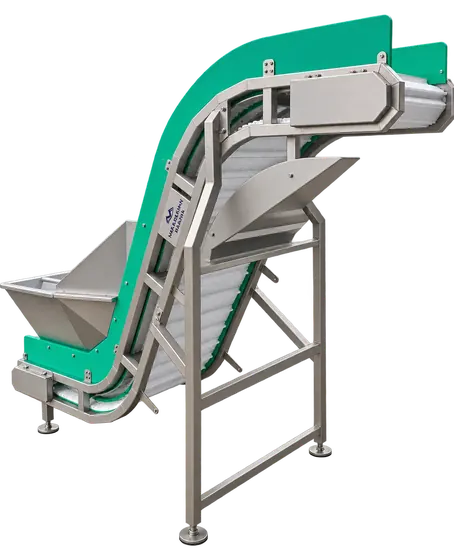
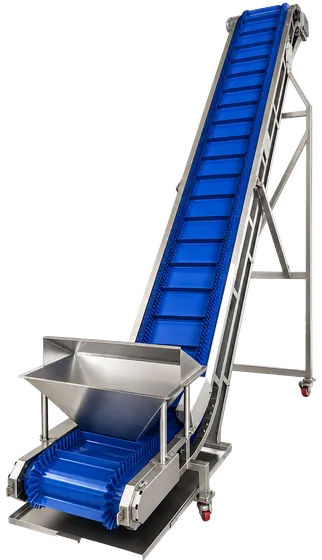
Side walls are flexible or fixed vertical strips along both edges of the belt. They make the belt a moving channel. On the positive-drive cleated elevator, cleats and side walls work together to keep the product on the belt while the sprocket drive carries it up the incline under control.
Side walls add three things:
- They stop sideways spill when the feed lands off-centre.
- They let the belt run fuller, because product has a boundary on both sides.
- They keep small pieces from falling into the gap between belt and frame.
They also take away something. A belt with side walls is harder to clean at the edges, and the corner between wall and belt traps soil and small pieces. If the line is washed down, that corner is a regular inspection point.
When a plain cleated belt is enough
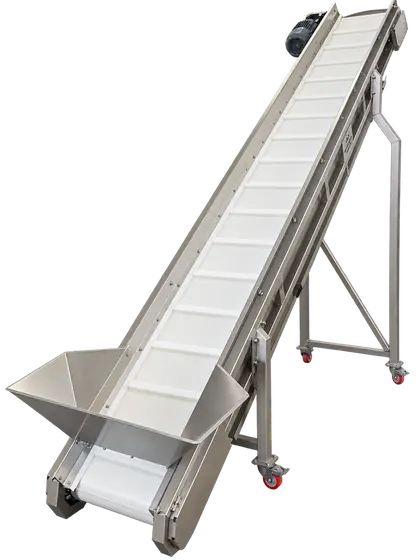
A wide trough and a cleated belt can carry a heavy product flow with no side walls when the product is large, the slope is moderate and the feed is centred. The cleated belt elevator lifts product from a low feed trough to the next machine on a PVC cleated belt, and the trough itself does part of the containing at the bottom of the lift. The trough stops at the incline, so the belt edge above it is open. If product leaves the belt at the upper part of the lift, the feed point is the first thing to check, before adding hardware.
Causes of rollback and spillage
- Wet belt. Water on a smooth PVC surface lowers the grip. Product that stays put on a dry belt slides on a wet one. Draining the product before the lift helps more than changing the belt.
- Cleat spacing too wide for the product. A piece that fits entirely between two cleats can still roll back over the lower one if the incline is steep.
- Uneven feed. Product dropped onto one edge pushes pieces toward the open side. Centre the drop with a chute or a distribution plate.
- Belt tracking. A belt that runs to one side brings its edge against the frame and lifts the side wall off the product. Tracking is its own subject and worth a regular check.
- Worn side walls. A wall that has lost its stiffness folds outward under load and opens a gap.
- Overfilling. The belt can only contain what fits behind the cleat and below the wall height. Product stacked above the wall will fall.
Checks on the machine
Run the elevator empty and watch the belt edge against the frame along the full length. The gap should be even on both sides. Then run it with product at the normal rate and look at three points: the feed point, the middle of the incline and the discharge.
At the feed point, check where the product lands on the belt. At the middle, look for pieces climbing over the cleat or sliding down behind it. At the discharge, look for product thrown past the receiving hopper, which is a separate issue from rollback and comes from belt speed and head pulley position.
Then stop the line and inspect the side wall corners and the underside of the belt. Soil in the corners and cracks at the base of the wall show where the next failure will begin.
Choosing between the options
The choice depends on the product shape, the slope and the cleaning routine. Round, heavy or wet product on a steep slope favours cleats plus side walls. Flat or irregular product on a moderate slope and a centred feed may need only cleats. If the line is washed daily, ask how the wall corners are cleaned before choosing walls, since a feature that cannot be cleaned becomes a hygiene problem.
For a complete line, the placement of each lift and its transfer points is described in the vegetable elevator types guide.